Why is hopcalite catalyst widely used in emergency gas protection fields?
Carbon monoxide (CO) is one of the most dangerous toxic gases in industrial and confined environments because it is colorless, odorless, and rapidly binds with hemoglobin, leading to oxygen deprivation in human tissues. In emergency respiratory protection systems, the key requirement is the immediate and reliable conversion of CO into non-toxic carbon dioxide under ambient conditions. Hopcalite catalyst, a manganese-copper oxide-based material, is widely adopted in this field because it can efficiently oxidize CO at room temperature without external heating, while maintaining fast reaction kinetics and stable performance under emergency conditions.
Technical Requirements of Emergency Toxic Gas Protection Systems
Emergency respiratory protection systems such as gas masks and confined-space rescue devices must meet strict catalytic performance requirements due to unpredictable and life-threatening exposure conditions. The most critical requirements include:
- Room-temperature activity: The catalyst must operate effectively between 0–60°C without preheating systems.
- High CO conversion efficiency: Typically required to exceed 90–99% under standard airflow conditions.
- Fast response kinetics: Reaction must begin immediately upon gas contact.
- Low pressure drop: Essential for breathing comfort in respiratory protection devices.
- Environmental tolerance: Ability to operate under variable humidity and oxygen levels.
In emergency scenarios, even a short delay in catalytic activation can result in severe CO poisoning. Therefore, catalysts used in these systems must combine high activity with immediate operational readiness.
Composition and Reaction Mechanism of Hopcalite Catalyst
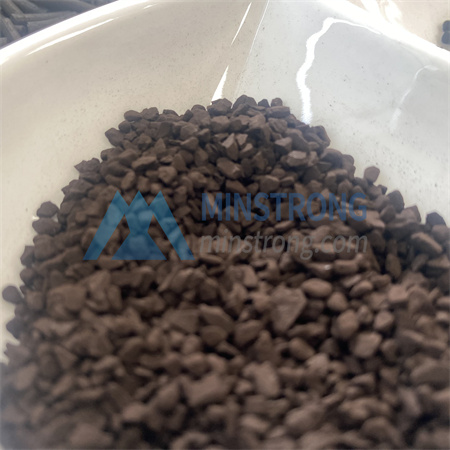
Hopcalite catalyst is typically composed of a mixed oxide system of copper (CuO) and manganese (MnO₂). The synergistic interaction between these metal oxides creates highly active redox sites that facilitate carbon monoxide oxidation.
The simplified reaction pathway is:
2CO + O₂ → 2CO₂
The mechanism can be described in three key steps:
1. CO adsorption: Carbon monoxide molecules are adsorbed onto active surface sites of the catalyst.
2. Oxygen activation: Oxygen molecules are activated on manganese-copper redox centers, forming reactive oxygen species.
3. Surface oxidation: CO reacts with active oxygen species to form CO₂, regenerating the active sites.
This continuous redox cycle allows the catalyst to maintain sustained activity without external energy input. The high dispersion of active phases ensures a large number of available reaction sites, which is critical for rapid CO removal.
Why Hopcalite Catalyst Is Suitable for Emergency Respiratory Protection Systems
The widespread use of Hopcalite catalyst in emergency respiratory applications is primarily due to its ability to function under ambient conditions where traditional catalytic systems fail.
Key advantages include:
- Low-temperature activity: Unlike noble metal catalysts requiring elevated temperatures, Hopcalite operates effectively at room temperature.
- Rapid CO oxidation kinetics: Enables immediate reduction of toxic CO concentrations.
- High conversion efficiency: Under proper oxygen supply, CO conversion can exceed 95–99%.
- Compact system compatibility: Suitable for integration into gas mask cartridges due to low bulk density and manageable pressure drop.
- No external energy requirement: Critical for portable and emergency-use systems.
Typical application environments:
- Mining rescue operations with sudden CO release
- Confined-space industrial accidents
- Fire aftermath environments with residual CO accumulation
- Emergency evacuation breathing systems
These scenarios share a common requirement: immediate gas detoxification without relying on powered equipment.
Influence of Environmental Conditions on Catalytic Performance
Although Hopcalite catalyst is highly effective, its performance is influenced by surrounding environmental conditions, particularly humidity, oxygen concentration, and contaminant gases.
1. Humidity effect
Water vapor competes with CO for adsorption sites and can block active catalytic centers. High humidity environments may significantly reduce catalytic efficiency unless protective desiccant layers are used.
2. Oxygen availability
Since oxygen is a reactant in CO oxidation, insufficient oxygen concentration directly limits conversion efficiency. Optimal performance is achieved in normal air conditions (~21% O₂).
3. CO concentration variation
At very high CO concentrations, catalytic sites may become temporarily saturated, leading to reduced conversion efficiency until equilibrium is restored.
Performance influence summary:
|
Condition
|
Effect on Performance
|
Explanation
|
|
High humidity
|
Activity decreases
|
Competitive adsorption of H₂O
|
|
Low oxygen
|
Conversion limited
|
Insufficient oxidant supply
|
|
Normal air
|
Optimal performance
|
Balanced reaction environment
|
Industrial and Emergency Application Logic of Hopcalite Catalyst
In practical engineering systems, Hopcalite catalyst is not only used in personal protective equipment but also integrated into broader emergency air purification modules.
Typical application logic includes:
- Post-incident gas cleanup: After combustion or chemical reaction events, CO concentrations may remain elevated in enclosed environments. Catalytic modules are used to rapidly restore air safety levels.
- Confined space safety systems: In tunnels, storage tanks, or underground structures, unexpected CO accumulation requires passive catalytic filtration systems.
- Emergency ventilation support: When mechanical ventilation is limited or unavailable, catalytic cartridges provide a non-powered detoxification layer.
These applications share a consistent engineering principle: converting toxic CO into stable CO₂ through passive catalytic oxidation without reliance on electrical or thermal systems.
Hopcalite catalyst remains one of the most established materials for emergency carbon monoxide removal due to its unique combination of room-temperature activity, fast reaction kinetics, and system compatibility. Its performance is fundamentally rooted in copper-manganese redox chemistry, making it a reliable solution for life-critical gas purification scenarios where speed and stability are essential.
author:kaka
date:2026/7/2


 minstrong