A Cost-Effective Solution for Low-Temperature CO Catalytic Oxidation
Industrial carbon monoxide (CO) emissions can be efficiently converted into harmless carbon dioxide (CO₂) through catalytic oxidation technology. Compared with high-temperature thermal oxidation and conventional precious metal catalysts, manganese-based carbon monoxide catalysts achieve efficient CO removal at much lower operating temperatures while reducing equipment investment, operating costs, and long-term maintenance expenses. For applications such as underground parking garages, industrial exhaust systems, air separation units, mining safety, and air purification, high-activity manganese-based catalysts offer an excellent balance between performance and cost-effectiveness. MINSTRONG MINSLITE-A is a high-performance CO oxidation catalyst developed based on this technology, designed to meet a wide range of industrial carbon monoxide removal requirements.
Why Do Industrial Facilities Need Carbon Monoxide Treatment?
Carbon monoxide (CO) is a colorless, odorless, and toxic gas primarily generated from incomplete combustion and certain industrial chemical processes. It is commonly found in boiler systems, industrial furnaces, waste incineration plants, air separation units, underground parking garages, mining operations, and chemical manufacturing facilities.
Because CO readily binds with hemoglobin in human blood, it significantly reduces oxygen transport capacity, posing serious health risks even at relatively low concentrations. Meanwhile, increasingly stringent environmental regulations worldwide require industries to reduce CO emissions. Therefore, installing an efficient, reliable, and economical carbon monoxide treatment system helps companies comply with emission standards while improving workplace safety.
Principle of Carbon Monoxide Catalytic Oxidation
Carbon monoxide catalytic oxidation utilizes active sites on the catalyst surface to accelerate the reaction between CO and oxygen:
2CO + O2 → 2CO2
The catalyst itself is not consumed during the reaction. Instead, it continuously provides active oxygen species and facilitates electron transfer, significantly accelerating the oxidation process.
Higher catalyst activity enables efficient CO conversion at lower temperatures, reducing both energy consumption and equipment investment. Therefore, low-temperature, highly active catalysts have become a major development direction for industrial CO treatment.
Comparison of Main CO Treatment Technologies
|
Technology
|
Operating Temperature
|
Energy Consumption
|
Initial Investment
|
Operating Cost
|
Typical Applications
|
|
Thermal Oxidation
|
>580°C
|
Very High
|
High
|
High
|
High-concentration exhaust gases
|
|
Precious Metal Catalysts
|
150–300°C
|
Medium
|
High
|
Medium
|
Fine chemicals, automotive exhaust
|
|
Manganese-Based Catalytic Oxidation (MINSLITE-A)
|
Room Temperature–150°C*
|
Low
|
Low
|
Low
|
Industrial exhaust, air purification, parking garages, mining
|
*Actual operating temperature depends on process conditions.
Compared with thermal oxidation, manganese-based catalytic oxidation eliminates the need for continuous high-temperature heating, significantly reducing energy consumption and capital investment. Compared with precious metal catalysts, manganese oxide catalysts utilize abundant transition metal oxides as active components, offering lower material costs while maintaining excellent catalytic performance.
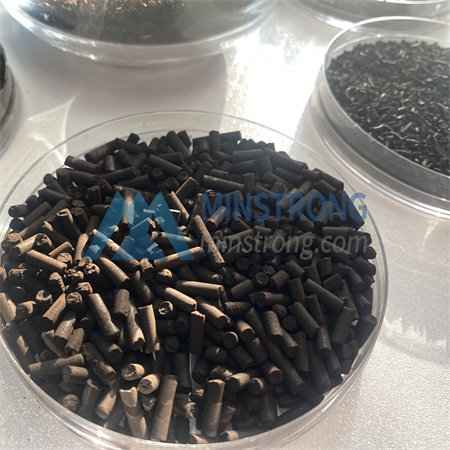
Why Does MINSLITE-A Deliver Excellent Cost Performance?
MINSTRONG MINSLITE-A adopts an advanced manganese-based mixed oxide catalytic system. Through optimized active component ratios and manufacturing technology, it delivers excellent CO oxidation activity even at relatively low temperatures.
-
Excellent low-temperature startup performance.
-
Highly active surface structure for improved CO and oxygen contact.
-
Lower material cost than precious metal catalysts.
-
Reduced energy consumption without continuous high-temperature heating.
-
Suitable for long-term continuous industrial operation.
For industrial systems operating around the clock, reduced energy consumption and extended service life significantly lower total lifecycle costs.
Technical Features of MINSLITE-A
The outstanding catalytic performance of MINSLITE-A originates from its nano-scale porous structure combined with a highly active manganese oxide system.
The catalyst possesses a large specific surface area that provides abundant active reaction sites. As CO contacts the catalyst surface, it rapidly reacts with adsorbed oxygen to form CO₂. Meanwhile, the catalyst continuously regenerates active oxygen through redox cycling, enabling continuous catalytic oxidation.
By optimizing crystal lattice structure and oxygen vacancy distribution, MINSLITE-A enhances oxygen activation efficiency, significantly improving low-temperature catalytic performance.
The catalyst is available in various configurations, including pellets, cylinders, and honeycomb structures, allowing flexible reactor design while balancing catalytic efficiency, pressure drop, and catalyst loading.
Typical Performance Parameters
|
Parameter
|
Typical Value
|
|
Operating Temperature
|
Room Temperature–150°C*
|
|
CO Removal Efficiency
|
Up to 99%+
|
|
Recommended Gas Hourly Space Velocity (GHSV)
|
5,000–50,000 h⁻¹
|
|
Catalyst Shapes
|
Honeycomb, Pellets, Cylinders
|
|
Pressure Drop
|
Low
|
|
Service Life
|
Several years under proper operating conditions
|
*Performance depends on actual process conditions.
In engineering projects, catalyst specification, loading volume, and reactor dimensions should be determined based on CO concentration, airflow rate, humidity, and emission requirements.
Typical Applications
-
Industrial boiler exhaust treatment
-
Chemical process exhaust purification
-
Underground parking garage ventilation systems
-
Air separation unit exhaust treatment
-
Mining safety equipment
-
Industrial combustion systems
-
Laboratory exhaust treatment
-
Air purification equipment
Different catalyst structures—including honeycomb and pellet types—can be selected according to airflow rate, pressure drop, and equipment configuration.
Important Operating Considerations
1. Control Moisture
High humidity may temporarily affect catalyst surface activity. Liquid water should be prevented from entering the catalyst bed. For high-humidity applications, preheating or dehumidification is recommended.
2. Prevent Catalyst Poisoning
Sulfur-, phosphorus-, silicon-, and halogen-containing compounds may reduce catalyst activity. Appropriate pretreatment systems should be installed whenever these contaminants are present.
3. Optimize Gas Space Velocity
Excessively high GHSV shortens gas residence time and may reduce removal efficiency, while excessively low GHSV increases equipment size. Proper reactor design optimizes both efficiency and investment cost.
4. Perform Routine System Inspection
Regular monitoring of pressure drop, CO concentration, and catalyst performance helps identify abnormal operating conditions and extends catalyst service life.
How to Select the Right Carbon Monoxide Catalyst
When selecting a CO oxidation catalyst, engineers should evaluate:
-
CO concentration
-
Exhaust gas temperature
-
Humidity level
-
Sulfur, chlorine, silicon, and other contaminants
-
Airflow rate
-
Emission requirements
-
Operating costs
-
Catalyst lifetime and maintenance intervals
Proper catalyst selection combined with optimized reactor design delivers superior treatment efficiency and long-term economic performance.
Frequently Asked Questions (FAQ)
Q1. Can MINSLITE-A operate at room temperature?
Under appropriate operating conditions, MINSLITE-A exhibits excellent catalytic activity near room temperature. Actual operating temperature depends on exhaust composition and project requirements.
Q2. Does the catalyst require continuous heating?
For many low-temperature applications, MINSLITE-A significantly reduces or even eliminates the need for additional heating, lowering overall energy consumption. Final operating conditions should be determined based on the specific process.
Q3. Does humidity affect catalytic performance?
High humidity may temporarily influence adsorption on the catalyst surface. Therefore, controlling inlet moisture and preventing liquid water from entering the catalyst bed are recommended.
Q4. What is the expected catalyst lifetime?
With proper pretreatment and operation within the designed process window, the catalyst can operate continuously for several years. Actual lifetime depends on exhaust composition, contaminants, and maintenance practices.
Q5. Which industries can use MINSLITE-A?
MINSLITE-A is suitable for industrial exhaust treatment, underground parking garages, air separation units, mining safety, air purification systems, combustion equipment, and many other applications requiring efficient CO removal.
Conclusion
As environmental regulations and occupational safety standards continue to become more stringent, industries increasingly demand carbon monoxide treatment systems that combine high efficiency, low operating costs, and long-term reliability. Compared with conventional thermal oxidation and precious metal catalysts, manganese-based catalytic oxidation offers significant advantages in low-temperature operation, lifecycle cost, and system stability. Leveraging its highly active manganese oxide catalytic system, nano-porous structure, and mature engineering design, MINSTRONG MINSLITE-A provides an efficient, reliable, and economical solution for industrial carbon monoxide removal, helping facilities improve workplace safety, reduce energy consumption, and achieve long-term compliance with emission regulations.
author:kaka
date:2026/7/15


 minstrong