How to optimize the working conditions to maximize the effectiveness of the Hopcalite catalyst?
The catalytic efficiency of Hopcalite catalyst is not a fixed value, but rather the result of synergistic interactions among operating parameters such as temperature, humidity, space velocity, and gas composition. Measured data show that under baseline conditions of 25°C, 40% relative humidity, and a space velocity of 20,000 h⁻¹, a sample with a copper‑to‑manganese molar ratio of 1:1.5 achieves an initial CO conversion of 98.2%; however, when the relative humidity rises to 80%, the CO conversion of the same sample drops from 96% to 43% within 2 hours. This gap indicates that maximizing the performance of Hopcalite catalyst requires systematic and precise regulation of operating parameters, rather than relying solely on the catalyst's intrinsic quality.
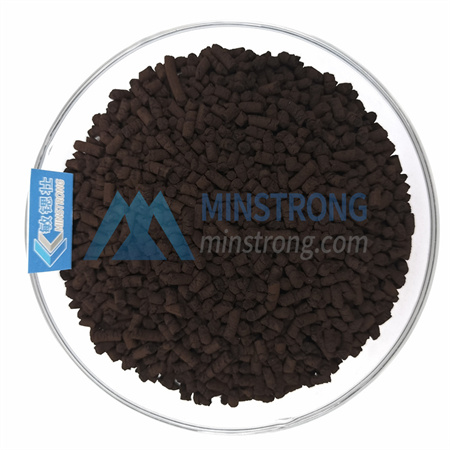
1. Catalyst Intrinsic Properties: The Material Foundation for Performance Optimization
Hopcalite catalyst uses manganese dioxide (MnO₂) and copper oxide (CuO) as its core active components. The copper‑to‑manganese molar ratio has a clear quantitative impact on catalytic activity: when the Cu:Mn ratio is between 1:1 and 1:2, the CO conversion at 25°C can exceed 90%, and the maximum space velocity can withstand up to 30,000 h⁻¹. Deviating from this range—excess copper reduces conversion to below 70%, while excess manganese decreases activity by about 30%.
Specific surface area and pore structure are equally critical. For Hopcalite catalysts used in low‑temperature CO oxidation, the BET specific surface area typically ranges from 120 to 220 m²/g; below 80 m²/g, the conversion at room temperature is unlikely to exceed 80%. Samples with a mesopore (2–10 nm) proportion exceeding 60% exhibit an apparent activity about 40% higher than those dominated by micropores. Furthermore, the calcination temperature directly affects crystallinity and activity: samples calcined at 280–350°C (low crystallinity) have a specific activity approximately 2.3 times that of samples calcined at 500°C (high crystallinity).
Case study: In an initial phase of a mine refuge chamber project, high‑crystallinity Hopcalite pellets calcined at 500°C were used, and it took 90 seconds to reduce the CO concentration from 400 ppm to 20 ppm; after switching to a low‑crystallinity product calcined at 320°C from the same manufacturer, the time to reach 20 ppm under the same conditions was only 55 seconds.
2. Temperature Window: Optimal at Ambient, Irreversible Damage at High Temperatures
The optimal operating temperature for Hopcalite catalyst is ambient (20–40°C). High‑performance products can initiate CO oxidation at temperatures as low as 0°C or even lower, but the reaction rate constant decreases significantly at low temperatures.
When the temperature exceeds 100°C, the active components undergo irreversible sintering. Although the catalyst can be used within an operating temperature range of 0–500°C, prolonged high‑temperature operation accelerates phase transformation and deactivation of the active components. Therefore, when the gas temperature is below 5°C or continuously above 60°C, it is usually necessary to compensate for efficiency loss by increasing the catalyst loading by 10–30%.
3. Humidity Control: The Most Critical Constraint
Water vapor is the primary cause of low‑temperature activity decline in Hopcalite catalyst in practical applications. When relative humidity increases from 30% to 80%, the CO conversion of a typical sample can drop from 96% to 43% within 2 hours. Under high‑humidity conditions, water molecules form a film on the catalyst surface, blocking contact between CO and active sites; at the same time, water molecules compete for adsorption with active sites.
When relative humidity exceeds 50%, to maintain the same outlet gas standard, the catalyst loading usually needs to be increased by 30–50%. For high‑humidity environments exceeding 70%, simply increasing the loading has limited effect; typically, a drying pre‑treatment unit is installed upstream of the catalyst bed.
Case study: A textile factory in southern China used ordinary Hopcalite to treat workshop CO exhaust (humidity ~70%), and the efficiency dropped to 65% within 2 months; after regeneration by heating at 180°C, the efficiency briefly recovered to 88%, but later switched to a moisture‑resistant modified product, which maintained 85% efficiency for 6 months.
4. Space Velocity and Concentration: Balancing Efficiency and Loading
Space velocity (GHSV) defines the volume of gas processed per hour per unit volume of catalyst. The higher the space velocity, the shorter the contact time between gas and catalyst, and the lower the conversion efficiency per pass. Recommended space velocity ranges vary significantly across different application scenarios: 8,000–15,000 h⁻¹ for continuous industrial tail gas treatment, and 15,000–25,000 h⁻¹ for intermittent respiratory protection equipment. Minstrong's granular Hopcalite products can tolerate space velocities from 3,000 to 80,000 h⁻¹.
In terms of inlet concentration, the catalyst bed depth required to reduce CO from 500 ppm to 10 ppm versus from 2000 ppm to 50 ppm is nonlinear—when the inlet concentration doubles, the required catalyst volume to maintain the same outlet concentration increases by approximately 1.5 to 2 times.
5. System Design and Maintenance: Ensuring Long‑Term Stable Operation
In engineering practice, efficient application of the catalyst relies on the synergy of "material properties + operating condition matching + system design". Key points include:
-
Gas pre‑treatment: Remove particulates, oil mist, and poisons such as sulfides before the gas enters the catalyst bed. Sulfides can deactivate the catalyst within hours under low‑temperature conditions.
-
Loading optimization: Avoid channeling and dead zones to ensure uniform gas distribution through the catalyst bed.
-
Regeneration: Thermal regeneration is the primary recovery method. Conventional regeneration parameters involve heating at 150–200°C; for water poisoning, the optimal parameters are heating at 100–130°C for 4–10 minutes. In a mine underground application case, deactivated catalyst was heated at 120°C for 8 minutes, and the catalytic efficiency recovered to 92% of the initial level.
Conclusion
Maximizing the performance of Hopcalite catalyst essentially involves, on the basis of understanding its intrinsic physicochemical properties (copper‑manganese ratio, specific surface area, crystallinity), precisely regulating three core parameters—temperature (ambient is optimal, avoid exceeding 100°C), humidity (keep below 50% if possible, pre‑dry if necessary), and space velocity (choose within 3,000–80,000 h⁻¹ depending on the scenario)—supplemented by proper gas pre‑treatment and periodic regeneration maintenance. Only by systematically implementing all the above aspects can the full performance potential of the catalyst be released.
author:kaka
date:2026/6/18


 minstrong