Application and Selection of Ozone Destruction Catalysts in Wastewater Treatment Plants
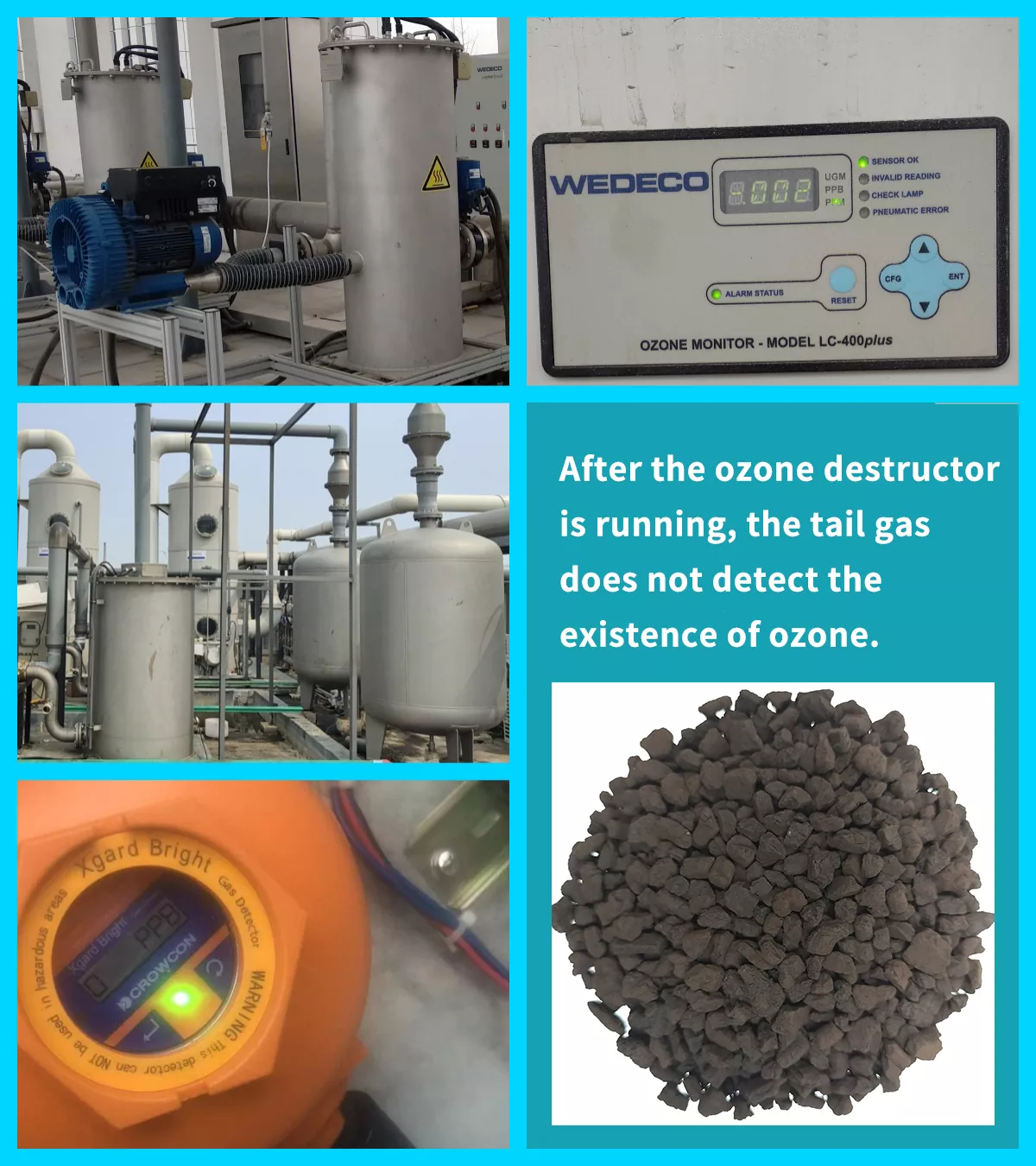
After using ozone for advanced treatment in wastewater treatment plants (such as decolorization, disinfection, and degradation of recalcitrant COD), the tail gas contains 0.5% to 3% residual ozone. If this tail gas is directly emitted, it contributes to ground-level ozone pollution, harming human health (respiratory irritation) and the surrounding environment. The ozone destruction catalyst is the core material of the key equipment to solve this problem, enabling the efficient catalytic decomposition of ozone (O₃) into oxygen (O₂) at room temperature.
Core Function and Technical Key Points of Ozone Destruction Catalysts
Their core function is to provide an efficient, low-energy-consumption solution for the ozone decomposition reaction under room temperature conditions.
1. Working Principle: The catalyst (typically using manganese dioxide, copper oxide as main active components) adsorbs ozone molecules, lowering the activation energy required for their decomposition into oxygen. This allows for rapid decomposition at the tail gas temperature of 30-60°C without the need for additional heating energy consumption.
2. Key Performance Indicators:
Conversion Efficiency: Under a space velocity of 5000-10000 h⁻¹, a high-efficiency catalyst should achieve an initial conversion rate of >99% for inlet ozone concentrations of 1-3%, ensuring the outlet concentration is below the 0.1 ppm safety limit.
Moisture Resistance: Wastewater plant tail gas is often saturated with humidity. A high-quality catalyst must possess high moisture resistance to prevent water molecules from permanently occupying active sites and causing efficiency decline.
Mechanical Strength and Lifespan: It must withstand airflow impact, with a typical normal service life of 3-5 years.
3. Application Form: The catalyst is usually formed into specific shapes (e.g., cylindrical, irregular pellets) and loaded into a reaction tower. As the tail gas passes through, ozone is decomposed. The key design considerations are ensuring uniform airflow distribution and sufficient contact time.
Analysis of Minstrong MINSLITE-B Series Ozone Destruction Catalyst Products
This product series is a typical catalyst designed for industrial ozone tail gas treatment, focusing on solving practical engineering challenges.
1. Core Characteristics:
High Activity and High Moisture Resistance: Through special carrier and preparation techniques, it maintains high activity even in environments with 95% relative humidity, making it suitable for directly treating saturated moisture-laden tail gas from wastewater plants.
Strong Stability: It contains no activated carbon, avoiding the risks of heat accumulation and combustion damage caused by the exothermic reaction of ozone oxidation, ensuring safe operation.
2. Key Parameters:
The main active components are transition metal oxides.
Typical specifications include cylindrical or irregular pellet forms, with multiple sizes available. Custom sizes can also be designed based on requirements.
Under the recommended space velocity, the destruction efficiency for typical inlet ozone concentrations is ≥99.9%.
3. Engineering Advantages:
Low Operating Cost: Operates at room temperature, requiring no additional energy consumption.
Easy Maintenance: Modular design facilitates installation and replacement. It has strong resistance to poisoning and high tolerance to common impurities in tail gas, such as trace organic matter and chlorine.
Summary
In the ozone process of wastewater treatment plants, equipping efficient, moisture-resistant ozone destruction catalysts is a necessary step to meet environmental emission standards and ensure safe production. Catalyst selection should focus on its conversion efficiency under actual humidity conditions, service life, and operational stability. Minstrong's ozone destruction catalysts, through targeted design, provide a reliable solution.


 minstrong